
Hello, and Happy Tuesday! Hope your day is going very well thus far. This week has started off fairly well here, although I am already behind on everything I was hoping to get done today. But that’s ok. It’s just that kind of day.
Every week I like to write about a deity from mythology, and I like choosing deities who are less well-known. I think there is something interesting about revisiting something that not many people have thought about in a long time. Long forgotten deities, once worshipped, now sit idly by in the dustbin of forgotten history, waiting for someone to pick them up and dust them off. Like items in an antique shop.
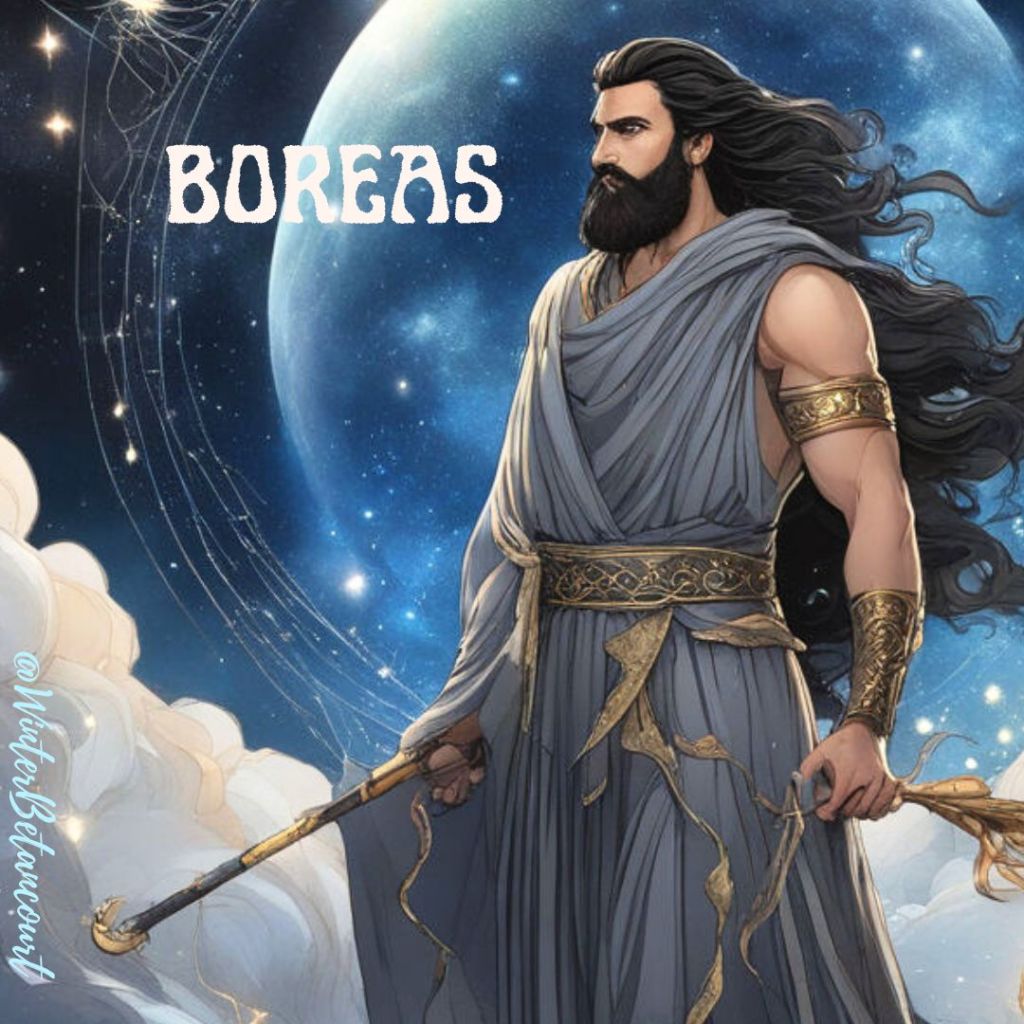
This week, I wanted to search out a mythological being associated with the seasons, especially with autumn. But who I came across first in my research was Boreas, the North Wind, aka The Devouring One. Not exactly related to the seasons, but definitely with the weather. And wow, what a name. Anyone who has ever walked through a cold, rainy wind can attest that this nickname sounds pretty spot on. His name alone made me want to learn more about him.
Boreas, also known as Aquilo in Latin, was the personification of the North Wind in Greek mythology. He was one of the four Anemoi, or wind gods, each associated with a cardinal direction. Boreas ruled over the cold and biting winds (the most unpleasant kind, in my opinion) that blew in from the north, and he was often depicted as a strong and fierce god, capable of unleashing powerful gales upon the world.
Boreas was the son of Eos, the goddess of the dawn, and Astraeus, the Titan of the dusk. This divine lineage made him a sibling to several other important deities, including Zephyrus (the West Wind), Notus (the South Wind), and Eurus (the East Wind). These four wind gods were responsible for controlling the winds and weather patterns in their respective directions.
One of the most famous stories involving Boreas centers around his infatuation with a mortal woman named Orithyia, who was the daughter of King Erechtheus of Athens. According to mythology, Boreas fell in love with Orithyia and attempted to woo her. However, when his advances were rebuffed, he resorted to more forceful means. In a disturbing twist, Boreas abducted Orithyia by carrying her away in his chariot of wind. He whisked her off to his secluded palace in the far north, where she eventually became his wife and bore him children. Boreas couldn’t accept not having what he wanted and resorted to force to get it. This was seen as an example of the brutality and unpredictability of the wind and the storms. Side-note, this theme of immortals kidnapping unwilling romantic partners is one of my least favorite (and to me, one of the most disturbing) themes throughout mythology, but is unfortunately extremely common in many myths, too many to count.
In another tale featuring Boreas, Helios (the Sun) and Boreas were involved in a contest to discover who was more powerful by seeing who could force a traveler to remove his traveling clothes. Boreas tore and ripped violently at the clothing with all his strength, but was unable to tear the cloak from the traveler’s shoulders. Helios then proceeded to move closer and turn up the strength of his rays, causing the traveler to strip the cloak and his traveling clothes and jump into a river. The moral was that in some cases it is more effective to be persuasive than to use force.
Boreas’s presence can be seen in various works of ancient art and literature. He is often depicted as a bearded man with windswept hair, wearing a flowing cloak and holding a conch shell or a gusting wind in his hand. Sometimes he has frost and ice in his hair as well. His image can be found on ancient coins, pottery, and sculptures, showcasing the importance of the North Wind in Greek culture.
In literature, Boreas is referenced in works such as Virgil’s “Aeneid” and Ovid’s “Metamorphoses.” His character serves as a symbol of nature’s unpredictable power and the role of the winds in shaping the world.
Boreas’s significance in Greek mythology extends beyond his role as a wind god. He embodies the harsh and unpredictable nature of the north wind, which can bring both destruction and renewal. In this way, he reflects the duality of the natural world and the Greek understanding of the forces that shaped their environment.
Boreas’s abduction of Orithyia symbolizes the idea that the natural world can be both beautiful and dangerous, a theme that recurs throughout Greek mythology. His character reminds us of the awe-inspiring power of nature and the need for respect and caution when facing its forces. For anyone who has witnesses the sheer destructive power of the wind in a hurricane, it is clear why the ancient Greeks would have developed a temperamental, often violent god to reflect the North Wind.
What do you think of this tempestuous god of wind? What are some of your favorite lesser-known characters from mythology?
Hoping you have a great rest of the day, and hoping it’s not a very windy one! Or at least not the cold, windy, rainy kind ❄️
-Winter
 Winter Betancourt
2 responses to “Boreas, The Devouring Wind”
Having had one of the panes of glass from our greenhouse blown out by very strong winds last January, I can attest that these winds can definitely wreak havoc when they wish!
LikeLiked by 1 person
Oh no! Absolutely, you are right!
LikeLiked by 1 person